
Covid-19 (July 21): 11,985 new cases, record 199 deaths
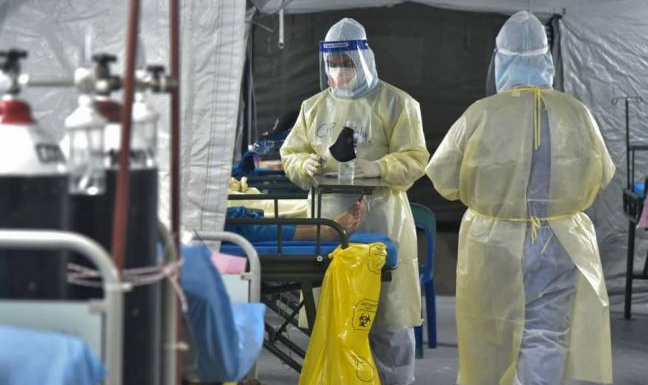
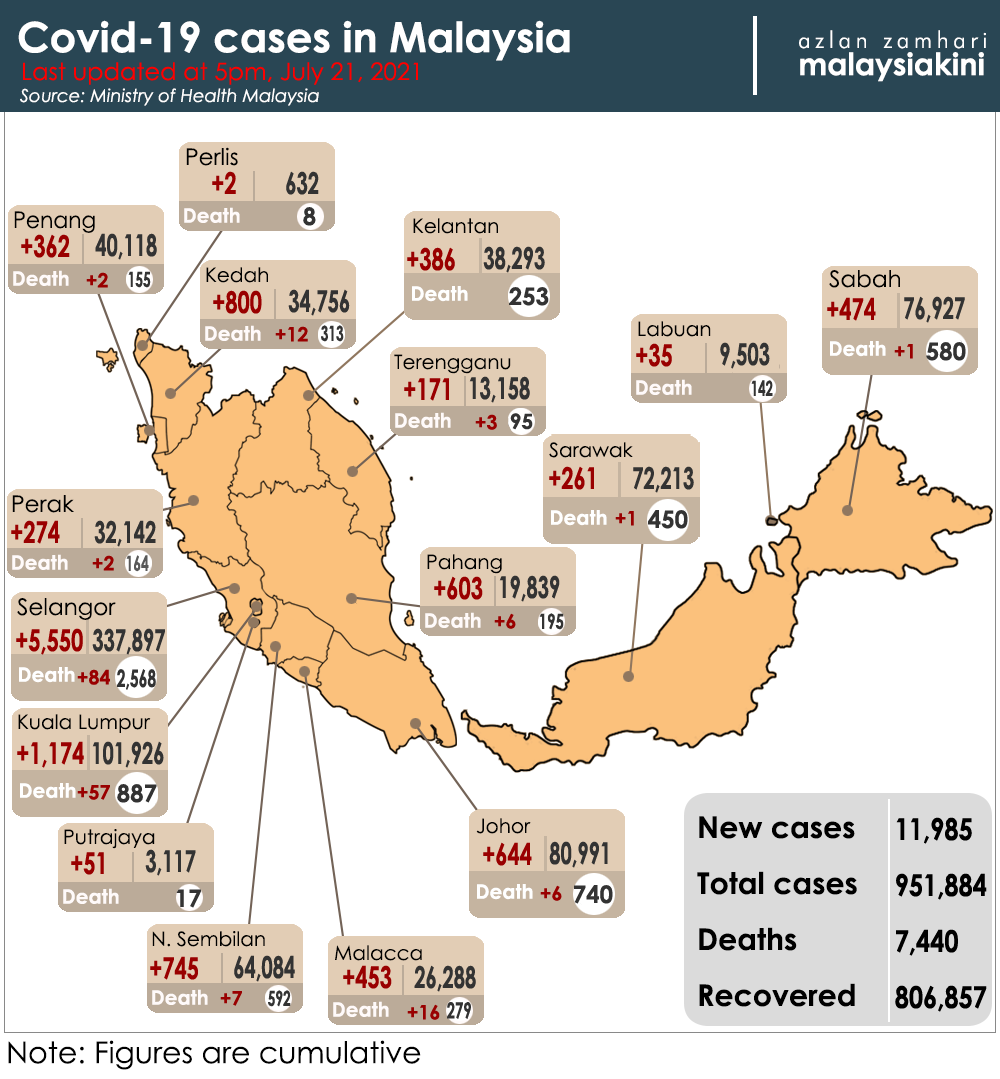
The Health Ministry today reported 11,985 new Covid-19 cases, as well as a record-breaking 199 deaths.
The previous record was 153 deaths recorded on July 18, which fell to 129 deaths on the next day and 93 yesterday.
The number of patients requiring intensive care or mechanical ventilation has also increased, compared to 924 ICU patients and 448 intubated patients yesterday.
- Active cases: 137,587
- Patients in ICUs: 927
- Intubated: 459
Health Ministry director-general Dr Noor Hisham Abdullah said most of the ICU admissions involve people in their 40’s and 50’s, rather than those above 60 years old.
“This situation proves that vaccines has helped reduced Covid-19 infectious among the old and infirm,” he said, urging adults below 60 to sign up for vaccination too.
Overall, 6,866 (57.3 percent) of today’s cases are detected through contact tracing, while 3,405 (28.4 percent) are detected through other forms of screening. Covid-19 clusters account for 1,707 cases (14.2 percent), while the remaining are imported cases.
Deaths
There were 199 fatalities today, bringing the death toll to 7,440.
Most of the deaths are recorded in the Klang Valley, with 84 cases in Selangor and 57 in Kuala Lumpur.
Elsewhere, 16 cases have been recorded in Malacca, 12 in Kedah, 7 in Negeri Sembilan, 6 in Johor, 6 in Pahang, 3 in Terengganu, 2 in Penang, 2 in Perak, 2 in Kelantan, 1 in Sabah, and 1 in Sarawak.
Of these, 33 of the deceased had died before being brought to a hospital – 21 in Selangor, 10 in Kuala Lumpur, 1 in Malacca, and 1 in Kelantan.
Forty two of today’s deaths have no history of chronic illness.
New cases by state
Klang Valley still remains the epicentre of new Covid-19 cases.
Kedah (800) set a new record today while a spike was noted in Kelantan (386) as well.
The numbers reported in Kelantan today were 65 percent higher than the threshold set to enter Phase 2 of the National Recovery Plan.
The R-naught for Malaysia is currently 1.12. A R-naught of more than 1.00 suggests that the spread of Covid-19 is accelerating.
The only regions with a R-naught of less than 1.00 is Sarawak, Labuan and Perlis.
Selangor (1.15) is still above the national average while Terengganu (1.31), Sabah (1.25) and Kedah (1.23) are regions with the highest R-naught figure.
- Selangor (5,550)
- Kuala Lumpur (1,174)
- Kedah (800)
- Negeri Sembilan (745)
- Johor (644)
- Pahang (603)
- Sabah (474)
- Malacca (453)
- Kelantan (386)
- Penang (362)
- Perak (274)
- Sarawak (261)
- Terengganu (171)
- Putrajaya (51)
- Labuan (35)
- Perlis (2)
Clusters
A total of 931 out of 3,329 clusters are still active. This includes the 30 new clusters reported today.
More than half of the clusters involved workplaces, while eight are classified as community clusters.
Two clusters involved high-risk groups and another two are linked to religious events. One cluster has been detected at a private educational institution.
Details of the new clusters are as follow:
Tapak Bina Jalan Langat
Category: Workplace
State(s): Selangor
District(s): Klang
Total infected: 40 out of 92 screened
Industri Jalan Jati Kiri
Category: Workplace
State(s): Selangor
District(s): Klang
Total infected: 55 out of 115 screened
Industri Anggerik Mokara 47
Category: Workplace
State(s): Selangor
District(s): Klang
Total infected: 19 out of 402 screened
Industri Sungai Kayu Ara 32
Category: Workplace
State(s): Selangor
District(s): Klang, Kuala Langat and Petaling
Total infected: 77 out of 419 screened
Industri Meranti Utama Satu
Category: Workplace
State(s): Selangor
District(s): Sepang
Total infected: 17 out of 338 screened
Jalan Seladang
Category: Workplace
State(s): Penang
District(s): Seberang Perai Tengah
Total infected: 22 out of 54 screened
Jalan Jelawat Satu
Category: Workplace
State(s): Penang
District(s): Seberang Perai Tengah
Total infected: 5 out of 230 screened
Industri Sungai Baong
Category: Workplace
State(s): Penang
District(s): Seberang Perai Selatan and Seberang Perai Tengah
Total infected: 14 out of 239 screened
Tingkat Mak Mandin Lima
Category: Workplace
State(s): Penang
District(s): Seberang Perai Utara
Total infected: 25 out of 268 screened
PLO Jalan Tembaga
Category: Workplace
State(s): Johor
District(s): Johor Bahru
Total infected: 14 out of 143 screened
Jalan Tanjong Puteri
Category: Workplace
State(s): Johor
District(s): Johor Bahru
Total infected: 10 out of 54 screened
Simpang Pinggiran Tongkang
Category: Workplace
State(s): Johor
District(s): Batu Pahat
Total infected: 19 out of 215 screened
Lorong Bukit Enam
Category: Workplace
State(s): Kuala Lumpur
District(s): Cheras
Total infected: 95 out of 115 screened
Dah Tapak Bina Pauh
Category: Workplace
State(s): Kedah
District(s): Pendang and Kuala Muda
Total infected: 18 out of 46 screened
Sawit Lung
Category: Workplace
State(s): Sabah
District(s): Beluran
Total infected: 15 out of 40 screened
Industri KKIP Selatan
Category: Workplace
State(s): Sabah
District(s): Kota Kinabalu and Tuaran
Total infected: 12 out of 66 screened
Pengkalan Barat 2
Category: Workplace
State(s): Perak
District(s): Kinta
Total infected: 9 out of 140 screened
Jalan Melor Ketereh
Category: Community
State(s): Kelantan
District(s): Kota Bharu
Total infected: 19 out of 32 screened
Kampung Sireh
Category: Community
State(s): Kelantan
District(s): Kota Bharu
Total infected: 9 out of 25 screened
Kampung Joh
Category: Community
State(s): Kelantan
District(s): Machang
Total infected: 18 out of 23 screened
Jalan Melur Tangkak
Category: Community
State(s): Johor
District(s): Tangkak
Total infected: 12 out of 16 screened
Jalan Paip
Category: Community
State(s): Johor
District(s): Tangkak
Total infected: 12 out of 13 screened
Sungai Sebatu
Category: Community
State(s): Sarawak
District(s): Meradong
Total infected: 33 out of 99 screened
Dah Kuala Jerlun
Category: Community
State(s): Kedah
District(s): Kubang Pasu
Total infected: 30 out of 37 screened
Nabun
Category: Community
State(s): Pahang
District(s): Lipis
Total infected: 21 out of 25 screened
Jalan Daud
Category: High-risk group
State(s): Kuala Lumpur
District(s): Titiwangsa
Total infected: 9 out of 35 screened
Lorong Ampang Dua
Category: High-risk group
State(s): Kuala Lumpur
District(s): Titiwangsa
Total infected: 25 out of 29 screened
Taman Sentosa Neram
Category: Religious event
State(s): Terengganu
District(s): Kuantan
Total infected: 27 out of 43 screened
Kampung Hujung Tanjung
Category: Religious event
State(s): Kelantan
District(s): Kota Bharu
Total infected: 11 out of 23 screened
Kampung Tengah Dalam
Category: Private educational institution registered under the Education Ministry
State(s): Johor
District(s): Kluang
Total infected: 30 out of 116 screened
Source:Malaysiakini
Covid-19 (July 20): 12,366 new cases; deaths lowest in a week
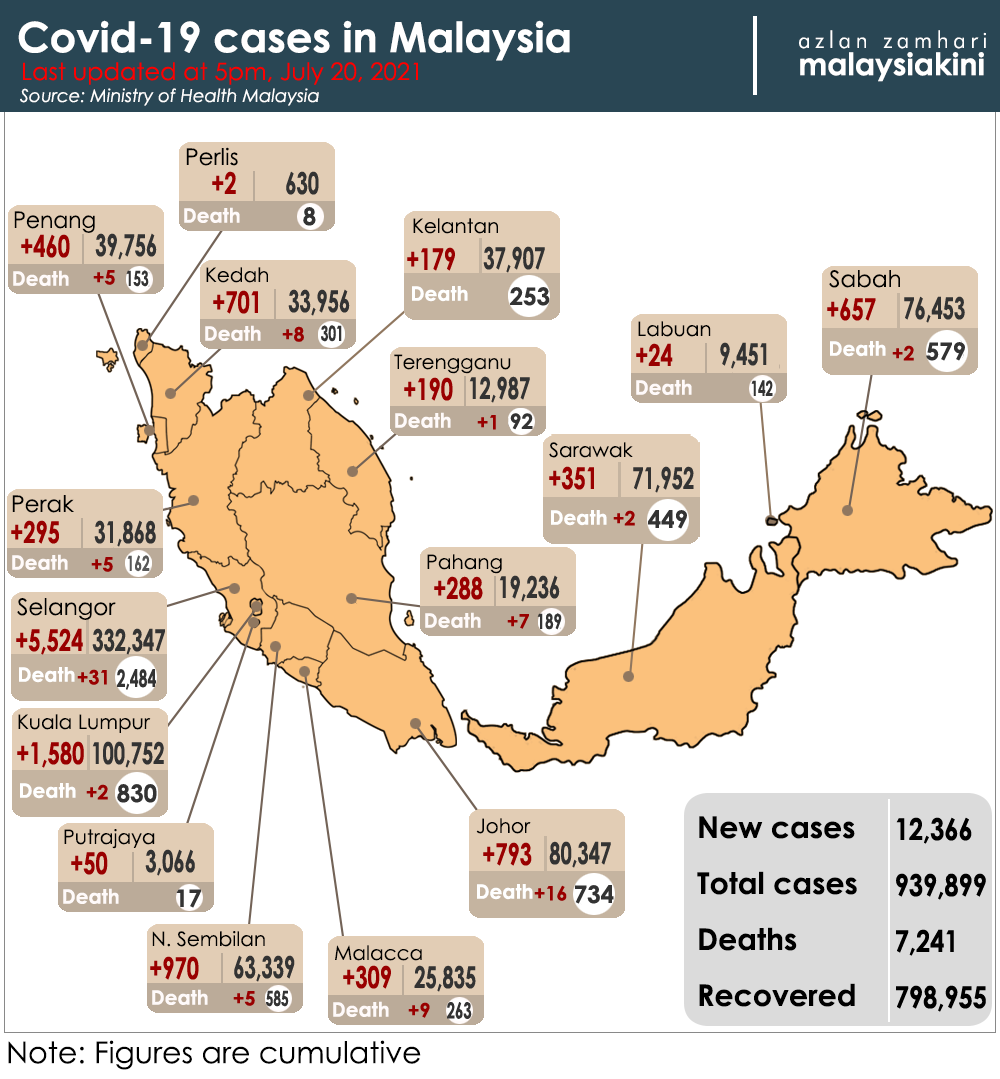
Malaysia has recorded 12,366 in the 24 hours up to noon today and 93 deaths.
Cases in Selangor exceed 5,000 once again with 5,524 cases reported, while Kuala Lumpur recorded 1,580 cases.
Cases in Kedah is also high with 701 recorded today, just slightly below yesterday’s record-high of 701 cases.
Meanwhile, in Sabah, Covid-19 cases in the last seven days averaged 515 cases per day including the 657 cases today.
This means it no longer meets one of the criteria for Phase 2 of the National Recovery Plan (average 479 cases per day over a week for Sabah), though the government had said states that have already entered Phase 2 would not revert to Phase 1 even if cases increase.
- Active cases: 133,703
- Patients in ICUs: 924
- Intubated: 448
On a more positive note, the number of Covid-19 deaths today is the lowest in more than a week after eight consecutive days of triple-digit figures.
Nevertheless, the number of ICU admissions and patients requiring mechanical ventilation has increased over the past few days.
Deaths
There were 93 fatalities today. This is the lowest since July 11 where 91 deaths were reported.
The 93 deaths bring the total death toll to 7,241.
Of these, 31 of the new deaths are recorded in Selangor, 16 in Johor, 9 in Malacca, 8 in Kedah, 7 in Pahang, 5 in Penang, 5 in Negeri Sembilan, 5 in Perak, 2 in Kuala Lumpur, 2 in Sabah, 2 in Sarawak, and 1 in Terengganu.
Ten of the deceased had already died when brought to a hospital. Such brought-in-dead cases are reported in Kedah (5), Malacca (3), Selangor (1), and Sabah (1).
New cases by states
- Selangor (5,524)
- Kuala Lumpur (1,580)
- Negeri Sembilan (970)
- Johor (793)
- Kedah (701)
- Sabah (657)
- Penang (460)
- Sarawak (351)
- Malacca (309)
- Perak (295)
- Pahang (288)
- Terengganu (190)
- Kelantan (179)
- Putrajaya (50)
- Labuan (17)
- Perlis (2)
Clusters
A total of 920 out of 3,299 clusters are still active. This includes the 18 new clusters reported today.
One of the new clusters involve an immigration detention depot, but most of the new clusters (13) are workplace clusters.
There are also two community clusters and two clusters involving high-risk groups.
Details of the new clusters are as follow:
Industri Jalan Haji Sirat
Category: Workplace
State(s): Selangor
District(s): Klang, Kuala Selangor and Petaling
Total infected: 140 out of 945 screened
Industri Persiaran Subang
Category: Workplace
State(s): Selangor
District(s): Petaling, Klang and Hulu Langat
Total infected: 107 out of 143 screened
Alam Jaya Lima
Category: Workplace
State(s): Selangor
District(s): Kuala Selangor
Total infected: 33 out of 107 screened
Industri Kenanga Satu
Category: Workplace|
State(s): Selangor
District(s): Hulu Selangor and Hulu Langat
Total infected: 20 out of 78 screened
Simpang Jeram
Category: Workplace
State(s): Johor
District(s): Muar
Total infected: 20 out of 29 screened
Jalan Sri Pelangi
Category: Workplace
State(s): Johor
District(s): Johor Bahru
Total infected: 17 out of 35 screened
Jalan Istimewa Dua
Category: Workplace
State(s): Johor
District(s): Johor Bahru and Kota Tinggi
Total infected: 14 out of 51 screened
Tapak Bina Jalan Kia Peng
Category: Workplace
State(s): Kuala Lumpur
District(s): Lembah Pantai
Total infected: 51 out of 297 screened
Jalan Berhala Merah
Category: Workplace
State(s): Kuala Lumpur
District(s): Lembah Pantai
Total infected: 12 out of 20 screened
Jalan Stadium
Category: Workplace
State(s): Kelantan
District(s): Kota Bharu
Total infected: 8 out of 22 screened
Industri Teknologi Cheng 30
Category: Workplace
State(s): Malacca
District(s): Alor Gajah and Melaka Tengah
Total infected: 68 out of 496 screened
Jalan Waterfront
Category: Workplace
State(s): Negeri Sembilan
District(s): Port Dickson
Total infected: 42 out of 116 screened
Pasar Besar Dungun
Category: Workplace
State(s): Terengganu
District(s): Dungun
Total infected: 51 out of 159 screened
Kampung Pukak
Category: Community
State(s): Sabah
District(s): Tuaran
Total infected: 17 out of 56 screened
Kampung Sungai Seputeh
Category: Community
State(s): Perak
District(s): Larut, Matang and Selama
Total infected: 10 out of 13 screened
Jalan Bukit Chagar
Category: High-risk group
State(s): Johor
District(s): Johor Bahru
Total infected: 61 out of 113 screened
Paya Luas
Category: High-risk group
State(s): Pahang
District(s): Temerloh, Bera, Jerantut, Maran and Bentong
Total infected: 101 out of 2,037 screened
DTI Bidor
Category: Detention Centre
State(s): Perak
District(s): Batang Padang, Hilir Perak, Kerian and Manjung
Total infected: 48 out of 352 screened
Source:Malaysiakini
Commentary: A pity China can’t seem to ditch its wolf warrior diplomacy

LONDON: In early June, President Xi Jinping called for a more “credible, loving and respectable” image of China.
While these comments suggested greater restraint from the more vocal of China’s “wolf warriors” – diplomats, journalists and think tankers who robustly defend China’s policies in public fora – their defensiveness has not subsided.
Leading Chinese English-language commentators continued to use abrasive language to defend China’s policies and deflect perceived slights from the US and overseas.
Perhaps Beijing continues to see its wolf warriors as a useful, perhaps even necessary, rhetorical tool to further China’s viewpoint and counter foreign criticism.
Perhaps they see them as an intractable part of a mosaic of foreign policy tools available to Beijing, from slickly edited videos presenting a softer image of China explaining things like the Five-Year Plan, to the harsh combative language of the wolf warriors attacking foreign critics.

READ: Commentary: Chinese officials have filled the Trump vacuum on Twitter
But it is far from clear that these aggressive defenders of China’s viewpoint improve Beijing’s international standing or overseas support of Chinese policy. Moreover, the patriotism stoked by these commentators is only feeding a tiger that Beijing is riding – a nationalism that can be hard to control.
HOWL OF THE WOLF WARRIORS
Even though the term “wolf warrior” comes from a 2015 Chinese film, wolf warrior diplomacy is nothing new for Chinese diplomats.
For decades, ambassadors, foreign ministry personnel and commentators have utilised acerbic language to sharply defend China’s policies. In 2010, then foreign minister Yang Jiechi responded to criticisms from the US by telling Southeast Asian counterparts that “China is a big country and you are small countries and that’s just a fact.”
In 1999, following the US accidental bombing of the Chinese embassy in Belgrade, an op-ed in the People’s Daily likened the US to Nazi Germany.
In 1967, Chinese diplomats engaged in a deeply undiplomatic scuffle with police outside the embassy in London, wielding blunt weapons and even an axe, amid tense Sino-British relations.
The current trend of wolf warrior diplomacy differs to these historical records in two key ways: Medium and volume.
READ: Commentary: Some soul-searching needed in China’s fresh push to make friends and influence people
Chinese diplomats today utilise globally popular English-language apps to disseminate their message.
This effectively enables individual diplomats to both reach a wider audience and to tailor messaging to specific groups overseas.
The most popular wolf warriors use media banned in China, such as Twitter and Facebook, which allow China’s diplomats and commentators to assert themselves in public on a far more frequent basis, ensuring a steady stream of invective designed to push China’s narrative.
WOLF PACK
Wolf warriors are not only more prolific than in the past. There are also now many more.
The number of Chinese diplomatic social media accounts has exploded in recent years. According to a May 2021 report by the Associated Press and Oxford Internet Institute, three quarters of the 270 active Chinese diplomatic profiles on Twitter joined since 2019.
Some are a function of new postings. Chinese ambassador to the UK, Zheng Zeguang, for instance, joined Twitter when he was posted overseas in his first high-level job.

But ambassadors with previous ambassadorial experience have also opened accounts after assuming their current appointments.
China’s ambassador to Iran, Chang Hua, was appointed in June 2019 and opened his Twitter account in October 2019. However, Chang also was previously ambassador to the UAE and Yemen, with no social media presence in those postings.
Similarly, Chen Weiqing, who was appointed ambassador to Saudi Arabia in May 2019, opened his Twitter profile in July 2019 but had no social media presence in his prior posting in Iraq.
Finally, some of these new accounts appear to have been opened for diplomats who had been in the post for several years. Zhang Yiming was appointed ambassador to Namibia in 2017 but didn’t open his twitter account until September 2019.
READ: Commentary: Some soul-searching needed in China’s fresh push to make friends and influence people
These suggest a coordinated attempt by Beijing to increase its diplomatic presence on major Western social media. The timing of this effort coincided closely with the protests in Hong Kong, when there was broad criticism of Beijing on social media.
Such accounts may attempt to defend China against foreign criticism. Not all will use deliberately provocative tactics to try to incite opinion.
Key leading wolf warriors, such as Zhao Lijian, deputy director general for the Ministry of Foreign Affairs Information Department, Hua Chunying, director general for the Information Department, and Hu Xijin, editor-in-chief of the nationalist newspaper, Global Times, comment on foreign affairs frequently and effectively act as trolls at times. The first two have more than 900,000 followers on Twitter.
READ: Commentary: China’s divide-and-conquer strategy isn’t fooling anyone anymore
Other wolf warriors also spontaneously hit out at foreign powers sometimes in a haphazard fashion that can seem unbecoming of a diplomat. Li Yang, consul general in Rio de Janeiro, called Canadian Prime Minister Justin Trudeau a “running dog of the US” in March, and recently mocked US efforts to rescue survivors from a building collapse in Miami.
Such incidents reinforce the impression of a centrally directed move to push back rhetorically on Western social media platforms, through a greater and more assertive presence, mirroring China’s foreign policy under Xi Jinping.
Yet not all diplomats use such indignant language, suggesting that there is no clear directive for all overseas representatives to be so aggressive. The decentralisation of messaging to diplomats also allows them to target their criticisms to the audience where they are posted.
READ: Ride-hailing giant Didi says it stores all China user data in China
READ: Commentary: Jack Ma brought the wrath of Chinese regulators down on Alibaba
But for the most strident of wolf warriors, garnering clicks through controversy helps them gain political capital through more hits on their statements and allows them to demonstrate the fiercest defence of China and Xi Jinping.
EXTERNAL EFFECTS
The effects of wolf warrior diplomacy have not necessarily been beneficial for Beijing. Some of the more incendiary comments and posts from wolf warriors have created diplomatic incidents.
In November 2020, Australia Prime Minister Scott Morrison demanded an apology after Zhao Lijian posted a tweet depicting an Australian soldier holding a bloody knife to the throat of a child.
Hua Chunying garnered negative headlines in March when she criticised accusations of forced labour in Xinjiang and used a “what-about” defence to point out the history of black slavery in the US.

The rise of China’s wolf warriors has also correlated with a rapidly worsening perception of China in a variety of other countries. A Pew Research Center survey from October 2020 highlighted this deterioration, with favourability ratings in countries such as the US and Australia dropping by 25 percentage points or more.
In most major Western European and Northeast Asian countries, China’s unfavourability ratings are now above 70 per cent, demonstrating a clear majority of people that see the country in a negative light.
A separate study by Yale in late 2020 suggested that the sharp language used by China’s wolf warriors runs counter to Chinese interests. The study concluded that “aggressive messages that attempt to tear down the United States do not have broad appeal”, while “messages that highlight foreign aid move public opinion in China’s favour.”
This all suggests that a more belligerent rhetoric from Chinese wolf warriors and foot soldiers has not only been unsuccessful in changing the hearts of its peers and rivals, but has also hardened overseas public opinion against China, making it harder for foreign leaders to develop more engaging policies towards China.
READ: Commentary: In China, authorities fear wanting to chill could fire off the next youth revolution
NATIONALISM AND STABILITY
Even with these negative effects, Beijing is unlikely to rein in its wolf warriors anytime soon.
Domestically, the wolf warriors play a useful role. They demonstrate to a Chinese audience that Beijing is more powerful and confident, and as a result willing to push back against international criticism.
In a country where the national narrative has been forged by the Chinese Communist Party around the concept of a “century of humiliation”, when China was forced to succumb to overseas interest and lost territories such as Hong Kong and Macau, such forceful messages present a stronger image of China.
These messages reflect the nationalist rhetoric that is often used on China’s social media sites, where patriotic users will highlight wolf warrior statements or replicate the sentiment.
Yet, the nationalism this stokes poses risks for Beijing in not only suppressing criticality from the national discourse, but also creating a patriotism that can be difficult to control.
In 2012, nationalist protests against Japan’s nationalisation of three small islands in the East China Sea were initially encouraged by Beijing as a public form of discontent.
But the protests got out of hand and became violent, leading to a crackdown by the authorities. While damage was relatively limited, it demonstrated that nationalism is a force that can be difficult to contain.
Such nationalism can lead to Beijing having to mitigate damaging diplomatic effects – in June, “patriotic” Weibo influencers branded Chinese academics who received Japanese government funds as traitors, requiring the foreign ministry to underline the “understanding, trust and deeper friendship” to be gained through such programmes.
READ: Commentary: China’s COVID-19 successes – credible at home, not so much abroad
In fact, there are signs Beijing may now recognise some of the harm wolf warriors do, with the Wall Street Journal reporting in late June that the Foreign Ministry is drafting guidelines for diplomats on the use of Twitter.
But ultimately China’s wolf warriors are an extension of China’s more assertive foreign policy under Xi: A voice to its policies that are here to stay.
It’s a pity the wolf warriors will keep baring their teeth and snarling at foreign critics, when it could be more helpful to listen to some overseas appraisals and see how to apply a charm offensive.
Christian Le Miere is a foreign policy adviser and the founder and managing director of Arcipel, a strategic advisory firm based in London.
Source: CNA/sl
Indonesia reports record number of doctor deaths from COVID-19 in July
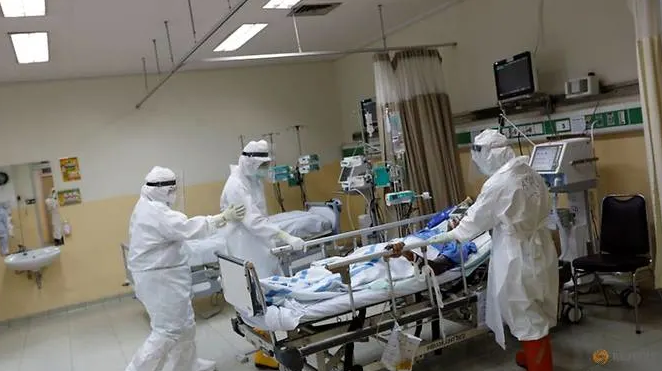
JAKARTA: Deaths of doctors from COVID-19 in Indonesia rose sharply in the first half of July, according to the profession’s association, as the Delta variant of the coronavirus fuelled a surge in infections across the country.
A total of 114 doctors died during Jul 1 to Jul 17, the highest number reported for any period of similar length and more than 20 per cent of the 545 total doctor deaths from COVID-19 since the beginning of the pandemic, officials from Indonesia’s doctors association (IDI) said during a virtual news conference.
Mahesa Paranadipa, a senior IDI official, said the association was concerned that the medical system may not be able to cope, according to a recording of the event.
“We are worried about the potential of a functional collapse,” Paranadipa said. “This is the reported data, not yet data that may not have been reported to us.”
Doctors’ deaths have increased in Indonesia, the world’s fourth most-populous nation, despite a 95 per cent vaccination rate among health workers. This has prompted the government to use a batch of Moderna vaccines as booster shots to China’s Sinovac for healthcare workers.
READ: Grappling with ‘worst-case scenario’, Indonesia faces more COVID-19 pain
READ: Indonesia considers extending restrictions on movement as COVID-19 cases climb
Fuelled by the spread of the more virulent Delta variant, Indonesia has reported more new coronavirus cases than any country in the world in recent days, data from the latest seven-day average from a Reuters tracker showed. It was second only to Brazil in terms of the number of deaths.
Health experts are calling the country the new epicentre of the pandemic. Indonesia reported 44,721 cases and 1,093 new deaths from the virus on Sunday (Jul 18).
The government imposed strict mobility curbs on Jul 3 to slow the spread of the virus. They are set to end on Tuesday, but may be extended.
Adib Khumaidi, head of the IDI’s mitigation team, did not immediately respond to Reuters’ requests for comments.
Source: Reuters/lk
Covid-19 (July 18): 10,710 cases, record 153 fatalities put death toll over 7k
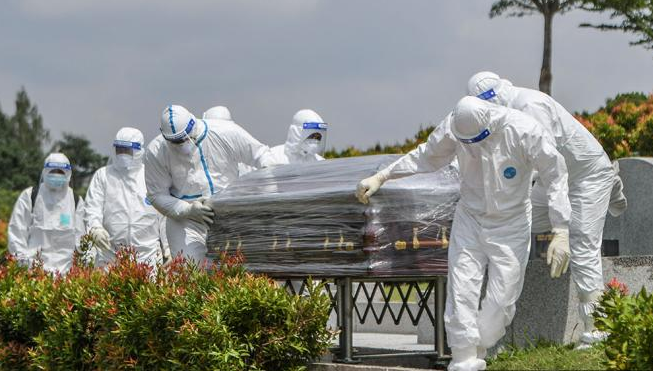
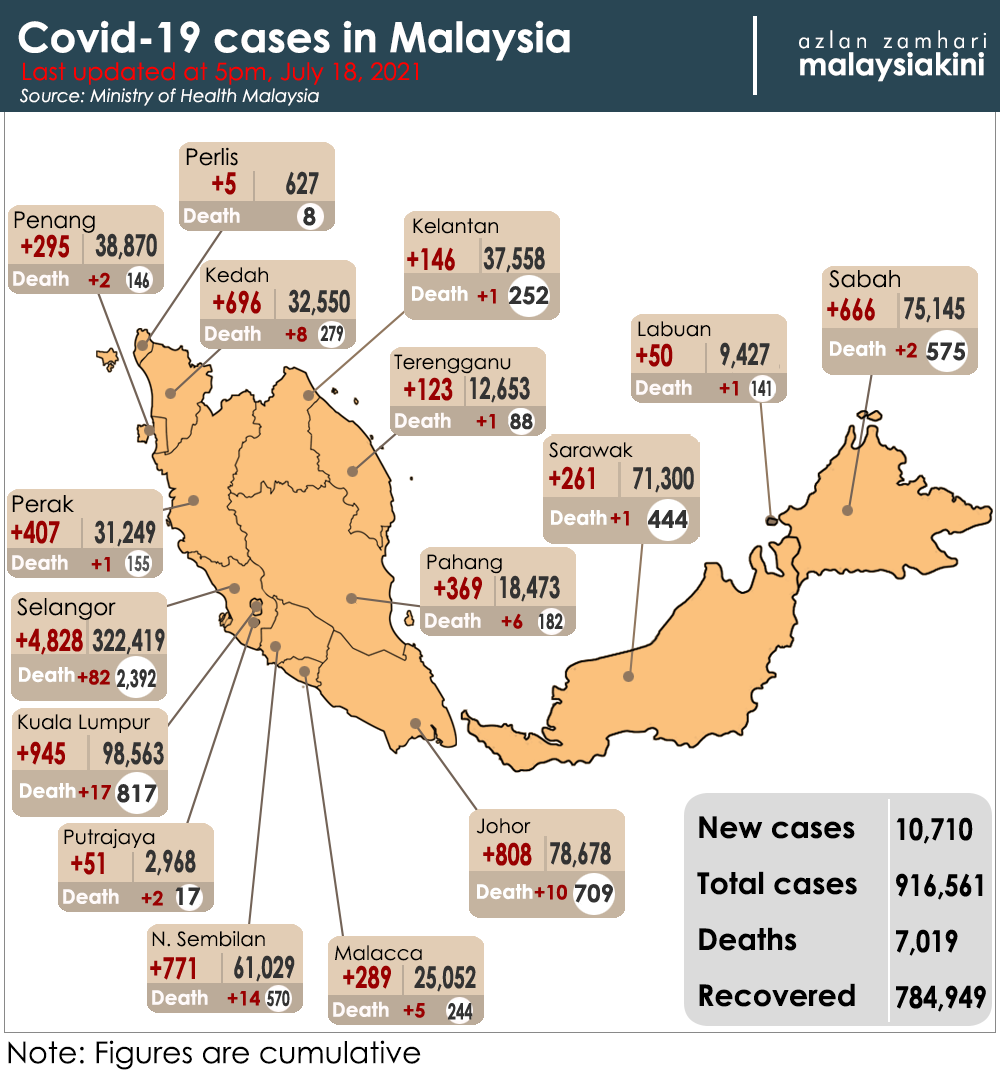
COVID-19 | The Health Ministry today reported 10,710 new Covid-19 cases.
Sabah (666) reported a record high. According to the state’s Covid-19 response minister Masidi Manjun, half of the new cases were from prisons.
Johor (808) saw fresh infections at a level not seen since February. New cases in the state have been steadily trending upwards over the past 28 days.
Active cases also crossed 120,000, putting unprecedented pressure on the healthcare system.
Out of the 10,710 cases, 95 are exhibiting Category 5 symptoms, which is the worst condition where patients are in a critical state and need a ventilator to breathe.
Another 45 are in Category 4 (need oxygen support) and 91 are in Category 3 (pneumonia). The remaining 4,162 and 6,317 are in Category 2 (mild symptoms) and Category 1 (asymptomatic) respectively.
As of yesterday, the national infectivity rate stood at 1.18.
- Active cases: 124,593
- Patients in ICUs: 909
- Intubated: 445
Deaths
There were 153 deaths today, a second consecutive day of record-setting fatalities. Yesterday, 138 people died.
A total of 1,849 people have died from the virus since the start of July.
The 153 fatalities put the death toll at 7,019.
Eighty-two of the deaths were in Selangor followed by Kuala Lumpur (17), Negeri Sembilan (14), Johor (10), Kedah (8), Pahang (6), Malacca (5), Sabah (2), Penang (2), Putrajaya (2), Terengganu (1), Sarawak (1), Kelantan (1), Perak (1) and Labuan (1).
New cases by states
Selangor (4,828)
Kuala Lumpur (945)
Johor (808)
Negeri Sembilan (771)
Kedah (696)
Sabah (666)
Perak (407)
Pahang (369)
Penang (295)
Malacca (289)
Sarawak (261)
Kelantan (146)
Terengganu (123)
Putrajaya (51)
Labuan (50)
Perlis (5)
Clusters
A total of 905 out of 3,250 clusters are still active.
This was in contrast to a total of 865 active clusters exactly a week ago.
There were 17 new clusters reported today.
A total of 10 out of the 17 new clusters were related to workplaces while five were community transmissions.
Details of the new clusters are as follows:
Industri Desa Aman
Category: Workplace
State(s): Selangor
District(s): Gombak and Petaling
Total infected: 46 out of 99 screened
Industri Jalan Klinik
Category: Workplace
State(s): Selangor
District(s): Klang
Total infected: 67 out of 452 screened
Persiaran Pekeliling Bangi
Category: Workplace
State(s): Selangor
District(s): Hulu Langat
Total infected: 17 out of 62 screened
Agathis
Category: Workplace
State(s): Sabah
District(s): Kalabakan
Total infected: 33 out of 84 screened
Sri Sandau
Category: Workplace
State(s): Sabah
District(s): Kinabatangan
Total infected: 11 out of 88 screened
Jalan Segambut Duta
Category: Workplace
State(s): Kuala Lumpur
District(s): Kepong
Total infected: 39 out of 60 screened
Industri Jalan Usaha 12
Category: Workplace
State(s): Malacca
District(s): Melaka Tengah
Total infected: 22 out of 132 screened
Dah Padang Temusu
Category: Workplace
State(s): Kedah
District(s): Kuala Muda and Pendang
Total infected: 36 out of 72 screened
Batu Enam Pandan
Category: Workplace
State(s): Johor
District(s): Johor Bahru
Total infected: 12 out of 74 screened
Lorong MIEL Lundang
Category: Workplace
State(s): Kelantan
District(s): Kota Bharu, Machang and Tumpat
Total infected: 6 out of 32 screened
Jalan Bacang 30
Category: Community
State(s): Johor
District(s): Johor Bahru
Total infected: 15 out of 82 screened
Jalan Tasek Seri Alam
Category: Community
State(s): Johor
District(s): Johor Bahru
Total infected: 17 out of 52 screened
Jalan Denai Utama
Category: Community
State(s): Johor
District(s): Johor Bahru
Total infected: 14 out of 31 screened
Dah Kampung Kerchut
Category: Community
State(s): Kedah
District(s): Kubang Pasu
Total infected: 25 out of 28 screened
Pos Iskandar
Category: Community
State(s): Pahang
District(s): Bera
Total infected: 36 out of 221 screened
Tembok Tawau Dua
Category: Detention Centre
State(s): Sabah
District(s): Tawau
Total infected: 159 out of 859 screened
Batu Tiga Utara
Category: High-risk group
State(s): Sabah
District(s): Sandakan
Total infected: 20 out of 20 screened
Source:Malaysiakini
Police fire rubber bullets, tear gas at protesters denouncing Thai PM

BANGKOK: Thai police deployed rubber bullets, tear gas and water cannon against protesters in Bangkok on Sunday (Jul 18) as demonstrators defied COVID-19 restrictions to call for Premier Prayut Chan-o-cha’s resignation and mark the one-year anniversary of a pro-democracy movement.
The kingdom is currently facing its worst COVID-19 wave, registering daily case records as hospitals buckle under pressure.
Exacerbating the toll has been the government’s slow procurement of vaccines, which has drawn criticism as Thailand’s economy reels from increasingly severe restrictions on businesses.
Defying rules prohibiting gatherings of more than five people, protesters piled mock body bags flecked with red paint near the intersection of the capital’s Democracy Monument.
“We will die from COVID-19 if we stay home, that is why we have to come out,” shouted a protest organiser, who listed three demands.
“Prayut Chan-o-cha must resign without any condition; the second is a budget cut to the monarchy and army to be used against COVID-19, and the third is to bring in mRNA vaccine.”

A giant banner with a picture of Prayut – the mastermind of a 2014 coup – was unfurled on the road, with protesters then stomping on his face.
As they marched on the Government House, they were led by a frontline group wearing gas masks and hard hats and were joined by motorbike drivers who hoisted the mock body bags.
But authorities deployed water cannon early and blocked the main road, forcing protesters to retreat.
Authorities also fired rubber bullets and tear gas, according to AFP reporters on the ground.
It sent protesters scattering, coughing non-stop as they tried to rinse their eyes with saline solution.
By late afternoon, the two sides were standing off as clouds of gas rose in the air.

It remains unclear how many were injured.
“JUST GIVE US GOOD VACCINES”
Exactly one year ago, thousands of protesters amassed at the Democracy Monument calling for Prayut’s resignation, the rewriting of the constitution and reforms to the kingdom’s long-unassailable monarchy.
Prayut had managed to hold onto power after 2019 elections – which were held under an army-scripted constitution – while popular opposition figures were increasingly hit with legal troubles.
That protest marked the beginning of a movement that has widened the discourse on taboo topics, including the role of the royal family – protected under a defamation law.
But as the impact of COVID-19 rapidly chipped away at Thailand’s economy, the government’s handling of the pandemic has become one of the movement’s main grievances.
Thailand announced earlier this week it would pair a dose of the Chinese-made Sinovac vaccine with the UK-developed AstraZeneca after authorities found that hundreds of medical staff who received Sinovac jabs had contracted the virus.
READ: Thailand defends COVID-19 vaccine ‘mix-and-match’ after WHO warning
READ: Thailand expands lockdown areas as COVID-19 cases surge
“You do not need to do any mix-and-match vaccines – just give us good vaccines,” demanded a young protester Sunday.
Acclaimed Thai director Apichatpong Weerasethakul also highlighted the country’s situation on Saturday during his acceptance speech for the jury prize at Cannes for “Memoriam”.
“I’m really lucky to be standing here and while many of my countrymen cannot travel. Many of them suffer greatly from the pandemic with the mismanagement of resources, of health care and vaccine accessibility,” he said.
“I want to call out for the Thai and Colombian government (where ‘Memoriam’ was filmed) … to please wake up and work for your people now.”
Thailand currently has more than 403,000 cases and a death toll of 3,341. Sunday saw a single-day record in new infections – more than 11,000 – while Saturday brought a new high in deaths with 141 dead.
Source: AFP/ga
At least 23 killed in landslide, wall collapse in Mumbai monsoon rains
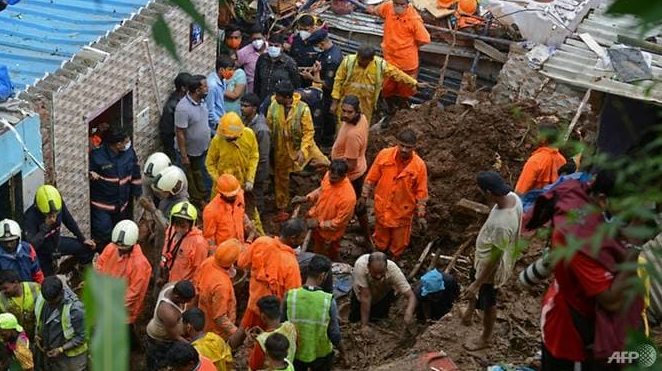
MUMBAI: At least 23 people were killed after several homes were crushed by a collapsed wall and a landslide triggered by heavy monsoon rains in India’s financial capital Mumbai, authorities said on Sunday (Jul 18).
Rainwater also inundated a water purification complex, disrupting supply “in most of the parts of Mumbai”, a megacity of 20 million people, civic authorities said.
A falling tree demolished a wall in the eastern suburb of Chembur during Sunday’s early hours, burying nearby residents, the National Disaster Response Force (NDRF) said.
Seventeen bodies have been recovered from the rubble, it added, with rescue operations ongoing.
“In the adjacent house, I saw a small girl who was trapped in the debris. She was shouting ‘save me, save me’,” Firoz Khan, who was caught up in the downpour in Chembur, told AFP.
“Her body was trapped in the mud. Somehow, I managed to pull her out. She had injuries in her legs. I narrowly survived this collapse.”
Another resident, Manda Gautam Pradhan, said she had seen “rocks and mud … gushing down the hill along with the rainwater”.
READ: 3-storey building collapses in India in heavy rain, kills 11
READ: At least 2 dead after heavy rains swamp hilly northern Indian state
In the suburb of Vikhroli in the city’s northeast, six people were killed after a landslide hit five homes early on Sunday, the NDRF added.
Building collapses are common during India’s June to September monsoon season, with old and rickety structures buckling under days of non-stop rain.
Last month, 12 people were killed when a building collapsed in a Mumbai slum.
And last September, 39 people died when a three-storey apartment block collapsed in Bhiwandi near the financial capital.
Mumbai has been hit by downpours since Saturday, with local transport services affected.
The city’s civic body did not say when the water supply was expected to be restored, but advised residents to boil the liquid before using it.
The Indian Meteorological Department said early Sunday that “moderate to heavy rain or thundershowers” were forecast for the next two days.
Prime Minister Narendra Modi tweeted his condolences and added that there would be financial compensation for victims’ families.
Source: AFP/ga
Covid-19 (July 17): New record of 138 deaths; 12,528 cases
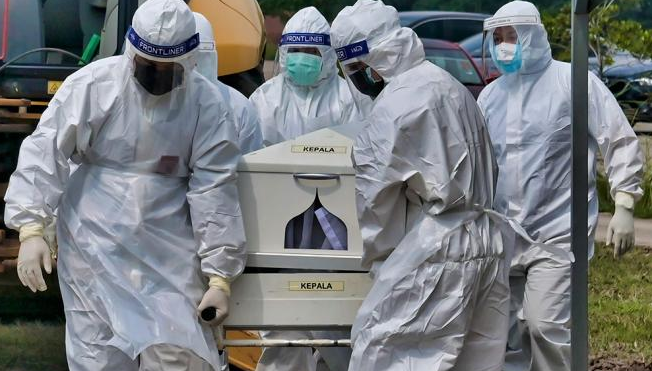
COVID-19 | The Health Ministry today reported 12,528 new Covid-19 cases with more than half of them in the Klang Valley.
There were also 138 fatalities, a new record.
The number of active cases crept closer to the 120,000 mark.
- Active cases: 119,814
- Patients in ICUs: 908
- Intubated: 425
In a breakdown provided by Health Ministry director-general Dr Noor Hisham Abdullah, 6,840 (54.6 percent) of the latest cases were asymptomatic.
Meanwhile, 5,468 (43.6 percent) had minor symptoms.
Another 112 had inflamed lungs, 44 needed oxygen, while 64 were in critical condition and required ventilators.
This breakdown does not mean those with asymptomatic or minor symptoms will not get worse, nor does it mean those badly affected will not recover.
Current data on how many of the active cases are with symptoms or without is not available to the public.
New cases by states
Selangor dipped slightly under 5,000 after remaining above that threshold for four consecutive days.
New cases in Kuala Lumpur also remain elevated at 1,740, only nine cases shy of the record high on July 14.
Likewise, Negeri Sembilan continued to record new cases in the four digits for the fifth consecutive day.
Fresh infections in Kedah climbed to a new record high of 701, beating the previous record of 695 on July 15.
Selangor (4,985)
Kuala Lumpur (1,740)
Negeri Sembilan (1,280)
Kedah (701)
Sabah (647)
Johor (625)
Malacca (569)
Perak (428)
Penang (396)
Sarawak (388)
Pahang (317)
Kelantan (211)
Terengganu (177)
Putrajaya (41)
Labuan (22)
Perlis (1)
Deaths
The 138 deaths pushed the national death toll to 6,866.
The new deaths were recorded in Selangor (46), Negeri Sembilan (20), Kuala Lumpur (16), Johor (16), Pahang (12), Malacca (11), Kedah (7), Perak (4), Penang (3), Terengganu (2), and Sabah (1).
Of the deceased, 120 died in hospital while 18 were brought in dead.
The Health Ministry has stopped providing a detailed breakdown of each fatality, including the ages of those deceased and comorbidities.
Clusters
A total of 906 out of 3,233 clusters are still active. This includes the 28 new clusters reported today.
Details of the new clusters are as follows:
Jalan Langsat Choh
Category: Workplace
State(s): Johor
District(s): Pontian
Total infected: 30 out of 78 screened
Jalan Penaga 18
Category: Workplace
State(s): Johor
District(s): Johor Bahru
Total infected: 11 out of 80 screened
Jalan Keluli Empat
Category: Workplace
State(s): Johor
District(s): Johor Bahru
Total infected: 46 out of 236 screened
Perindustrian PLO 34
Category: Workplace
State(s): Johor
District(s): Kulai
Total infected: 12 out of 52 screened
Lorong Perusahaan 10
Category: Workplace
State(s): Penang
District(s): Seberang Perai Tengah
Total infected: 16 out of 155 screened
Lorong Jelawat
Category: Workplace
State(s): Penang
District(s): Seberang Perai Tengah and Seberang Perai Utara
Total infected: 31 out of 717 screened
Lorong Perusahaan 8B
Category: Workplace
State(s): Penang
District(s): Seberang Perai Tengah, Seberang Perai Selatan and Seberang Perai Utara
Total infected: 57 out of 705 screened
Lorong Perusahaan Baru Tiga
Category: Workplace
State(s): Penang
District(s): Seberang Perai Tengah, Seberang Perai Utara and Seberang Perai Selatan
Total infected: 17 out of 103 screened
Saujana Putra Satu
Category: Workplace
State(s): Selangor
District(s): Kuala Langat and Petaling
Total infected: 75 out of 492 screened
Industri Alam Perdana
Category: Workplace
State(s): Selangor
District(s): Kuala Selangor
Total infected: 49 out of 105 screened
Industri Saujana Teratai
Category: Workplace
State(s): Selangor
District(s): Kuala Selangor
Total infected: 14 out of 17 screened
Tapak Bina Jalan Batu View
Category: Workplace
State(s): Kuala Lumpur
District(s): Kepong
Total infected: 141 out of 327 screened
Jalan Limau Purut
Category: Workplace
State(s): Kuala Lumpur
District(s): Lembah Pantai
Total infected: 23 out of 26 screened
Tapak Bina Jalan Awan Besar
Category: Workplace
State(s): Kuala Lumpur
District(s): Lembah Pantai
Total infected: 270 out of 287 screened
Industri Jalan Usaha 13
Category: Workplace
State(s): Malacca
District(s): Melaka Tengah
Total infected: 29 out of 220 screened
Industri Lot 11 Tangga Batu
Category: Workplace
State(s): Malacca
District(s): Melaka Tengah
Total infected: 150 out of 585 screened
Industri Lot Lima Batu Berendam
Category: Workplace
State(s): Malacca
District(s): Melaka Tengah and Alor Gajah
Total infected: 34 out of 852 screened
Industri Jalan TJ Utara
Category: Workplace
State(s): Negeri Sembilan
District(s): Seremban
Total infected: 48 out of 61 screened
Industri Chembong
Category: Workplace
State(s): Negeri Sembilan
District(s): Rembau
Total infected: 60 out of 226 screened
Kampung Tanjung Tok Sadang
Category: Community
State(s): Kelantan
District(s): Kota Bharu
Total infected: 12 out of 20 screened
Kampung Bujuk
Category: Community
State(s): Kelantan
District(s): Pasir Mas
Total infected: 14 out of 17 screened
Kampung Kepas
Category: Community
State(s): Kelantan
District(s): Machang
Total infected: 7 out of 12 screened
Rantau Melor
Category: Community
State(s): Pahang
District(s): Jerantut
Total infected: 7 out of 25 screened
Jambatan Liawan
Category: Community
State(s): Sabah
District(s): Keningau
Total infected: 45 out of 256 screened
Bedup Longgo
Category: Community
State(s): Sarawak
District(s): Serian
Total infected: 25 out of 93 screened
Lorong Chinniah
Category: High-risk group
State(s): Selangor
District(s): Klang
Total infected: 16 out of 21 screened
Paya Datuk
Category: High-risk group
State(s): Malacca
District(s): Alor Gajah, Melaka Tengah and Jasin
Total infected: 58 out of 294 screened
Jalan Seri Tawar
Category: Non-Education Ministry institution
State(s): Penang
District(s): Seberang Perai Utara
Total infected: 12 out of 21 screened
Source:Malaysiakini
Covid-19 (July 16): 12,541 cases, 7,116 in Klang Valley
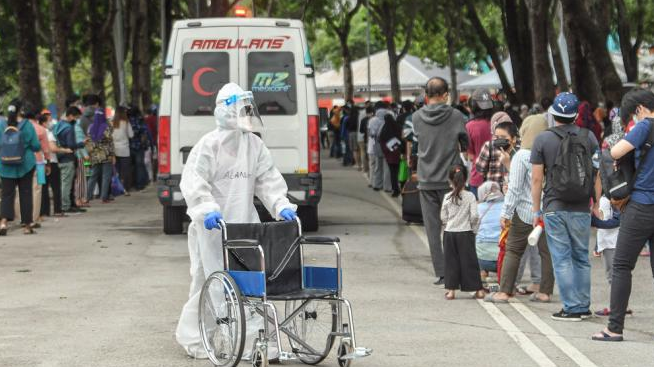
COVID-19 | The Health Ministry reported 12,541 cases of Covid-19 today.
This is the fourth day in a row that cases have exceeded 10,000.
- Active cases: 114,053
- Patients in ICUs: 896
- Intubated: 459
There were 7,116 cases in the Klang Valley with Selangor reporting 5,512 cases – the second-highest on record.
Negeri Sembilan, meanwhile, recorded another record high with 1,619 cases – the fourth consecutive day that cases have exceeded 1,000.
Johor‘s 609 cases today is the highest since June 20.
Deaths
There were 115 fatalities today, bringing the death toll to 6,728.
These are 53 cases in Selangor, 24 in Kuala Lumpur, 7 in Johor, 7 in Malacca, 5 in Penang, 4 in Negeri Sembilan, 4 in Kedah, 3 in Sabah, 3 in Perak, 2 in Kelantan, 2 in Terengganu, and one in Labuan.
New cases by states
Clusters
A total of 893 out of 3,205 clusters are still active. This includes the 37 new clusters reported today.
Nineteen of the new clusters involve workplaces, and another eight are community clusters.
Four new clusters involve detention facilities, three involve high-risk groups, and three involve educational facilities.
Details of the new clusters are as follow:
Satu Lagenda
Category: Workplace
State(s): Malacca
District(s): Melaka Tengah and Alor Gajah
Total infected: 39 out of 304 screened
Tapak Bina Jalan Lagong
Category: Workplace
State(s): Selangor
District(s): Gombak
Total infected: 37 out of 54 screened
Jalan Mayang Pasir
Category: Workplace
State(s): Penang
District(s): Barat Daya and Timur Laut
Total infected: 33 out of 302 screened
Industri Alam Jaya Tiga
Category: Workplace
State(s): Selangor
District(s): Kuala Selangor
Total infected: 31 out of 33 screened
Lorong Baiduri Satu
Category: Workplace
State(s): Pahang
District(s): Maran, Jerantut and Temerloh
Total infected: 27 out of 71 screened
Industri Lot Satu
Category: Workplace
State(s): Malacca
District(s): Melaka Tengah
Total infected: 26 out of 872 screened
Lorong Gemia
Category: Workplace
State(s): Terengganu
District(s): Kuala Terengganu, Marang, Hulu Terengganu and Kuala Nerus
Total infected: 24 out of 144 screened
Jalan Mahkota Kuantan
Category: Workplace
State(s): Pahang
District(s): Kuantan
Total infected: 21 out of 162 screened
Jalan Setiawangsa 11
Category: Workplace
State(s): Kuala Lumpur
District(s): Titiwangsa
Total infected: 20 out of 35 screened
Persiaran Cassia Selatan Satu
Category: Workplace
State(s): Penang
District(s): Seberang Perai Selatan
Total infected: 17 out of 260 screened
Lorong IKS Juru Tiga
Category: Workplace
State(s): Penang
District(s): Seberang Perai Tengah
Total infected: 16 out of 88 screened
Wakaf Che Yeh
Category: Workplace
State(s): Kelantan
District(s): Kota Bharu
Total infected: 16 out of 49 screened
Industri Jalan Rukun Dua
Category: Workplace
State(s): Selangor
District(s): Kuala Selangor
Total infected: 14 out of 20 screened
Setapa
Category: Workplace
State(s): Johor
District(s): Kota Tinggi
Total infected: 13 out of 62 screened
Jalan Gunung 32
Category: Workplace
State(s): Johor
District(s): Johor Bharu
Total infected: 12 out of 40 screened
Jalan Chengal Temerloh
Category: Workplace
State(s): Pahang
District(s): Temerloh
Total infected: 12 out of 65 screened
Seksyen 11 Jalan Maju
Category: Workplace
State(s): Kelantan
District(s): Kota Bharu, Machang and Pasir Mas
Total infected: 10 out of 21 screened
Jalan Lok Heng
Category: Workplace
State(s): Johor
District(s): Kota Tinggi
Total infected: 10 out of 30 screened
Persiaran SIBC Satu
Category: Workplace
State(s): Perak
District(s): Perak Tengah
Total infected: 8 out of 49 screened
Jalan Bangsar
Category: Community
State(s): Kuala Lumpur
District(s): Lembah Pantai
Total infected: 131 out of 518 screened
Tok Jiring
Category: Community
State(s): Terengganu
District(s): Kuala Nerus
Total infected: 33 out of 122 screened
Lempaong
Category: Community
State(s): Sarawak
District(s): Betong
Total infected: 31 out of 55 screened
Kampung Alor Hijau
Category: Community
State(s): Kelantan
District(s): Pasir Puteh
Total infected: 25 out of 55 screened
Bukit Tinggi
Category: Community
State(s): Sarawak
District(s): Meradong
Total infected: 21 out of 29 screened
Kampung Lubuk Pusing
Category: Community
State(s): Perak
District(s): Manjung
Total infected: 21 out of 54 screened
Kampung Kukup
Category: Community
State(s): Johor
District(s): Pontian
Total infected: 18 out of 46 screened
Terusan Utama
Category: Community
State(s): Selangor
District(s): Sabak Bernam
Total infected: 16 out of 35 screened
Bakti 2
Category: Detention Centre
State(s): Negeri Sembilan
District(s): Seremban and Rembau
Total infected: 402 out of 639 screened
Kolam Air 2
Category: Detention Centre
State(s): Kedah
District(s): Kota Setar, Kubang Pasu and Pendang
Total infected: 94 out of 208 screened
Tembok Choh 3
Category: Detention Centre
State(s): Johor
District(s): Johor Bharu
Total infected: 79 out of 110 screened
Tembok Tawakal Kluang
Category: Detention Centre
State(s): Johor
District(s): Kluang
Total infected: 49 out of 79 screened
Batu Tujuh Jalan Kebun
Category: High-risk group
State(s): Selangor
District(s): Klang
Total infected: 55 out of 58 screened
Pekan Ranau
Category: High-risk group
State(s): Sabah
District(s): Ranau
Total infected: 15 out of 296 screened
Mahkota Batu 19
Category: High-risk group
State(s): Johor
District(s): Kulai and Johor Bahru
Total infected: 6 out of 132 screened
Jalan Pulai Indah 27
Category: Non-Education Ministry institution
State(s): Johor
District(s): Johor Bharu
Total infected: 14 out of 49 screened
Jalan Cengal Selatan
Category: Non-Education Ministry institution
State(s): Kuala Lumpur
District(s): Titiwangsa
Total infected: 13 out of 18 screened
Putra Bertam
Category: Non-Education Ministry institution
State(s): Penang
District(s): Seberang Perai Utara
Total infected: 11 out of 30 screened
Source:Malaysiakini
New Zealand PM Ardern discussed COVID-19 vaccines with US President Biden ahead of APEC meet

WELLINGTON: Prime Minister Jacinda Ardern discussed efforts to ensure vaccine availability in New Zealand and the Pacific region in a call with US President Joe Biden on Friday (Jul 16), the New Zealand government said in a statement.
The call comes ahead of the Asia-Pacific Economic Cooperation (APEC) Informal Leaders’ Retreat on COVID-19 to be held on Friday.
“President Biden and I discussed the forthcoming APEC leaders meeting and the critical importance of working together as a region to navigate out of the COVID-19 pandemic,” Ardern said in a statement released to the media.
“We also discussed the vaccine roll-out, both domestically and in the Pacific region and both our countries’ efforts to ensure vaccine availability,” she added.
Among those attending the retreat are Singapore’s Prime Minister Lee Hsien Loong and China’s President Xi Jinping.
READ: New Zealand’s Ardern to host emergency APEC COVID-19 summit
The meeting on Friday is aimed at bolstering vaccine roll-outs to contain the fast-spreading coronavirus variants now fuelling the pandemic.
The virtual meeting, called with less than five days’ notice, would also examine the 21-nation APEC group’s response to its biggest economic crisis since World War II, Ardern said.
“It’s a unique opportunity to get APEC leaders together to discuss how we get our region through the health crisis and accelerate economic recovery,” she told reporters on Thursday.
New Zealand is scheduled to host an online summit of APEC leaders in November but Ardern said the extraordinary circumstances created by COVID-19 warranted an additional urgent meeting.
At the meeting, Ardern will argue for increased resources for the COVAX programme, which was set up to ensure equitable distribution of vaccines but has struggled to secure enough doses for low-income nations.
READ: New Zealand’s Ardern says special APEC meeting to focus on economic impact of pandemic
While 70 per cent of the population is vaccinated in some developed countries, the figure is less than 1 per cent for low-income countries, according to the United Nations.
Ardern also wants greater powers for the World Health Organization (WHO), as well as the establishment of cross-border systems to rapidly identify and respond to future pandemics.
“It’s clear our global community was not adequately prepared for COVID-19, it’s also clear that COVID-19 will not be the last global health risk that we face,” she said.
On trade, Ardern said leaders needed to ensure global supply chains remained open and resist the urge to “turn inward” because of the pandemic.
APEC trade ministers had already agreed last month to expedite the trade of COVID-19 vaccines and medical material across the region, she added.
But Ardern played down expectations of major announcements from Friday’s meeting, saying it was primarily an opportunity to bring leaders together to collectively discuss current challenges.
Source: Reuters/mi
 English
 简体中文
简体中文 Bahasa Indonesia
 Bahasa Melayu