
Covid-19 (July 5): 6,387 new cases, more than half in Klang Valley

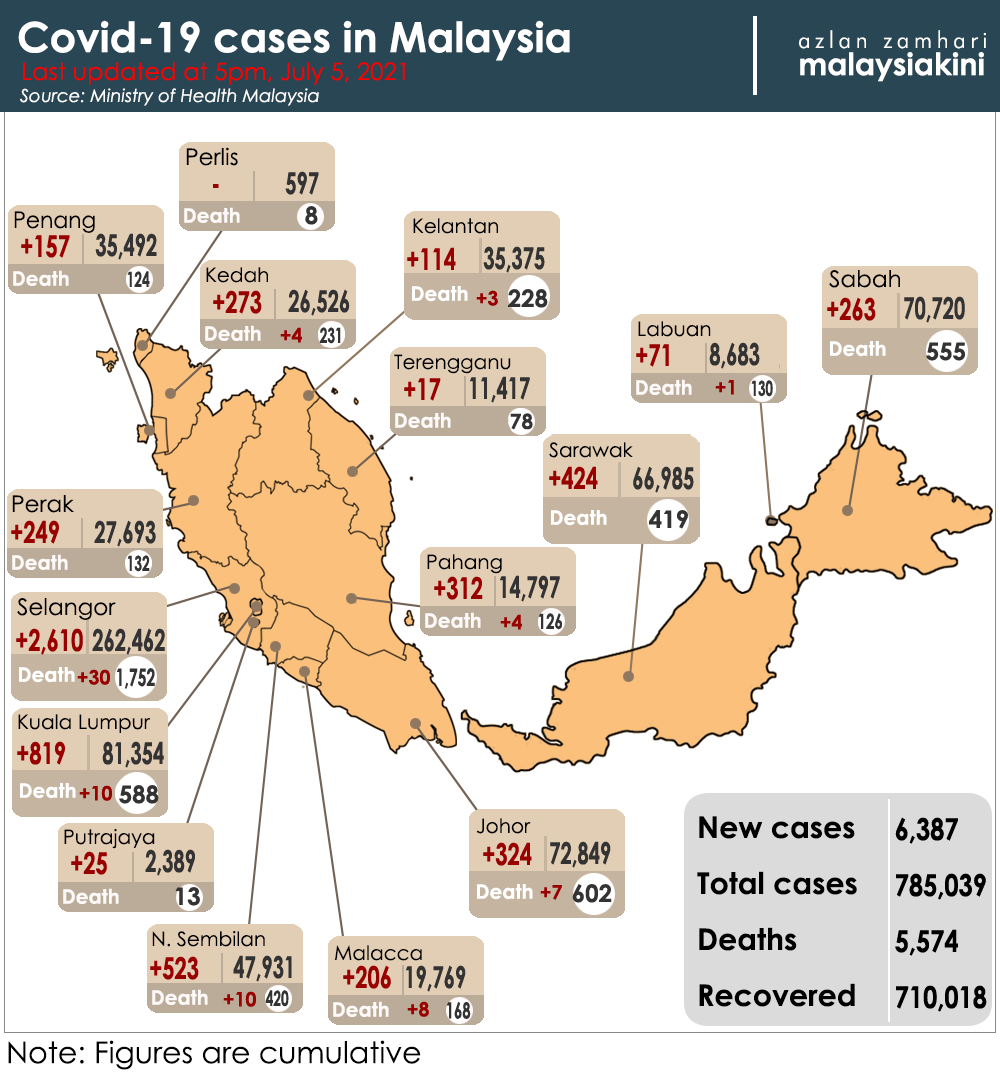
COVID-19 | The Health Ministry today reported 6,387 new Covid-19 cases with the Klang Valley making up more than half of the fresh infections.
Active Covid-19 cases are on an 11-day uptrend while the number of patients needing intensive care is almost at record levels.
- Active cases: 69,447
- Patients in ICU: 923
- Intubated: 433
New cases by state
- Selangor (2,610)
- Kuala Lumpur (819)
- Negeri Sembilan (523)
- Sarawak (424)
- Johor (324)
- Pahang (312)
- Kedah (273)
- Sabah (263)
- Perak (249)
- Malacca (206)
- Penang (157)
- Kelantan (114)
- Labuan (71)
- Putrajaya (25)
- Terengganu (17)
- Perlis (0)
Selangor reported 2,610 new cases, the seventh consecutive day where daily fresh infections were above 2,000.
One in eight new Covid-19 cases in Selangor were detected among those who reported symptoms but were not linked to existing clusters nor were they close contacts to Covid-19 positive cases.
Kuala Lumpur also saw elevated levels with 819 new cases.
As of last night, the R-naught figure for the country is 1.06, down slightly. A R-naught figure of more than 1.00 suggests that the spread of Covid-19 was accelerating.
The only regions where the R-naught was less than 1.00 are Johor, Kelantan, Labuan, Negeri Sembilan, Terengganu, Perlis and Sarawak.
Deaths
There were 77 deaths attributed to Covid-19 that were reported today. The national death toll has reached 5,574.
Selangor (30) reported the most deaths followed by Kuala Lumpur (10), Negeri Sembilan (10), Malacca (8), Johor (7), Pahang (4), Kedah (4), Kelantan (3) and Labuan (1).
There were 13 victims who were already pronounced dead when they were brought to the hospital.
Details of the victims are documented in Malaysiakini’s Covid-19 tracker page.
Clusters
The Health Ministry is currently monitoring 855 Covid-19 clusters, down from a peak of 887 on June 29. This is a good sign.
Another 13 clusters were classified today, which includes 11 workplace clusters.
Industri Tech Valley Sendayan cluster
Category: Workplace
State(s): Negeri Sembilan
District(s): Seremban and Port Dickson
Total infected: 17 out of 118 screened
Industri TTJ 2 cluster
Category: Workplace
State(s): Negeri Sembilan
District(s): Seremban, Kuala Pilah and Tampin
Total infected: 31 out of 632 screened
Jalan Harmoni Sembilan cluster
Category: Workplace
State(s): Johor
District(s): Johor Bahru
Total infected: 11 out of 56 screened
Jalan Sri Sulong cluster
Category: Workplace
State(s): Johor
District(s): Batu Pahat
Total infected: 13 out of 80 screened
Lorong Berjaya cluster
Category: Workplace
State(s): Sabah
District(s): Kota Kinabalu
Total infected: 8 out of 104 screened
Jalan Kayu Madang cluster
Category: Workplace
State(s): Sabah
District(s): Kota Kinabalu and Tuaran
Total infected: 18 out of 184 screened
Industri Bentong Sebelas 2 cluster
Category: Workplace
State(s): Pahang
District(s): Bentong
Total infected: 9 out of 445 screened
Industri Jerantut Feri cluster
Category: Workplace
State(s): Pahang
District(s): Jerantut
Total infected: 6 out of 58 screened
Industri 121 Kuala Baram cluster
Category: Workplace
State(s): Sarawak
District(s): Miri
Total infected: 132 out of 221 screened
Dah Satu Industri Kulim cluster
Category: Workplace
State(s): Kedah
District(s): Kulim, Baling and Bandar Baharu
Total infected: 52 out of 87 screened
Lintang Macallum Dua cluster
Category: Workplace
State(s): Penang
District(s): Timur Laut
Total infected: 64 out of 261 screened
Kampung Bakong Gunong cluster
Category: Community
State(s): Kelantan
District(s): Bachok
Total infected: 10 out of 28 screened
Kampung Bechah Tembesu cluster
Category: Community
State(s): Kelantan
District(s): Kota Bharu
Total infected: 10 out of 22 screened
Source:Malasiakini
Australians trapped in COVID-19 vaccine ‘Hunger Games’, says top official
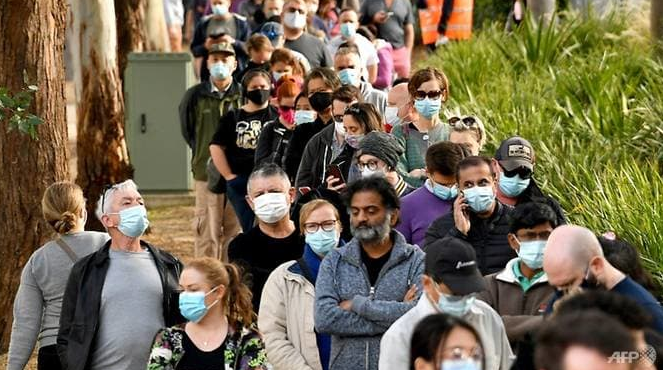
SYDNEY: Getting vaccinated in Australia is like “the Hunger Games” a top health official admitted on Monday (Jul 5), as the country battles scarce supplies during a growing COVID-19 outbreak.
A vaccine shortage has led to panicked efforts by people looking to get jabbed, said Brad Hazzard, health minister for the country’s most populous state New South Wales.
“It is almost a sense now of the Hunger Games of people chasing vaccine,” he said of desperate residents turning up at mass vaccination centres or making regular calls to medical facilities in the hope of securing an appointment.
Set in a dystopian future, the wildly popular Hunger Games books and films saw a group of young people selected annually to participate in a televised battle to the death.
READ: Australia’s New South Wales says next 2 days ‘critical’ as COVID-19 outbreak grows
Just 7 per cent of Australia’s roughly 25 million residents have been fully vaccinated, one of the lowest proportions for any developed nation.
The country’s conservative government bet heavily on AstraZeneca, and developing a homegrown vaccine, which failed in trials.
Many Australians have shunned the available AstraZeneca offering – now only recommended for those aged over 60 – and tried to secure appointments to get the Pfizer-BioNTech shot.
But the odds have not been in their favour as efforts to get more doses of Pfizer-BioNTech and other vaccines remain hampered by late decisions on ordering and limited global supply.
Prime Minister Scott Morrison is under growing pressure to increase the vaccination rate, as an outbreak in locked-down Sydney grew to more than 300.
Australia has seen 30,000 virus cases since the pandemic began, but several major cities imposed snap lockdowns to limit small outbreaks in recent weeks.
Hazzard said it was “easy to be critical” of the federal government’s efforts in hindsight, “but I think they did their best”.
But he warned that “until we get enough vaccine – and enough GPs actually at the frontline able to provide that vaccine into arms – we will continue to have effectively the Hunger Games going on here”.
Last week, Morrison revealed a four-stage plan to reopen Australia’s borders and end the cycle of snap lockdowns, a plan which depends on a large portion of the population being vaccinated.
Source: AFP/kg
Explosives set off to bring down rest of collapsed Florida condominium
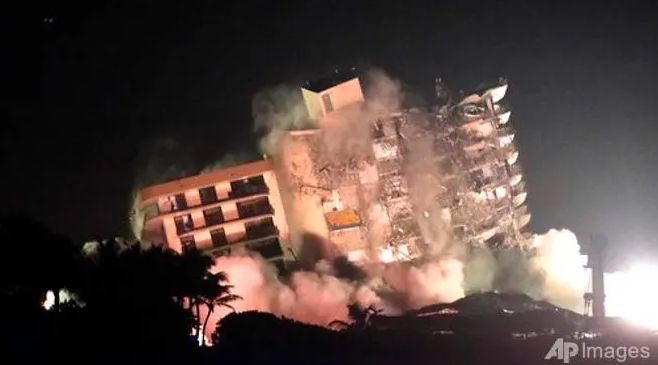
SURFSIDE, Florida: Demolition crews set off explosives late on Sunday (Jul 4) to bring down the damaged remaining portion of a collapsed South Florida condominium building, a key step to resuming the search for victims as rescuers possibly gain access to new areas of the rubble.
Video footage showed the 12-story Champlain Towers South in Surfside, outside Miami, being demolished 10 days after most of the building collapsed in the early hours of Jun 24. The confirmed death toll from the disaster is 24, with 121 people missing.
Crews were to begin clearing some of the new debris so rescuers could start making their way into parts of the underground garage that is of particular interest.
Once there, rescuers are hoping that they will gain access for the first time to parts of the garage area that are a focus of interest, Miami-Dade Assistant Fire Chief Raide Jadallah has said.
That could give a clearer picture of voids that may exist in the rubble and could possibly harbour survivors.
No one has been rescued alive since the first hours after the Jun 24 collapse.

The precarious, still-standing portion of a collapsed South Florida condo building was rigged with explosive charges and set for demolition overnight, Miami-Dade County officials said late Sunday.
The search-and-rescue mission at the Surfside building was suspended on Saturday afternoon so workers could begin to drill holes for explosives.
Jadallah said the suspension was a necessary safety measure because the drilling could cause the structure to fail, but a family member could be heard calling that news “devastating”.

READ: Surfside pushes back on report on delayed building repairs
Rescuers will await the “all-clear” after the demolition and then immediately dive back into the task of trying to locate any survivors buried under the rubble, County Mayor Daniella Levine Cava said. Officials had previously said that the search could resume from 15 minutes to an hour after the detonation.
“We are standing by. We are ready to go in, no matter the time of night,” Levine Cava told a news conference Sunday night.
Jadallah said earlier that up to 210 rescuers will be poised to restart the search as soon as the site is declared safe after the blast.

READ: Miami condo collapse: Most residents in sister building opt to stay put
Officials had evacuated residents around the site ahead of the demolition and warned others to stay indoors and close windows, doors and any other openings that could allow dust in.
“Once this building is down, it’s going to be a green light, full speed ahead, maximum effort to pull these victims out and reunite them with their family,” Surfside Mayor Charles Burkett told CBS’ Face the Nation.
“There’s nobody in charge really talking about stopping this rescue effort … This rescue effort as far as I’m concerned will go on until everybody is pulled out of that debris.”

Concerns had mounted that the damaged Champlain Towers South building in Surfside was at risk of falling on its own, endangering the crews below and preventing them from operating in some areas.
The approach of Tropical Storm Elsa added urgency to the demolition project. The latest forecasts have moved the storm westward, mostly sparing South Florida, but meteorologists have said the area could still feel effects starting Monday.
Investigators have not determined what caused the 40-year-old complex to collapse on Jun 24. A 2018 engineering report found structural deficiencies that are now the focus of inquiries that include a grand jury examination.
Source: AP/ec
Biden marks ‘independence’ from COVID-19, but pandemic remains a threat
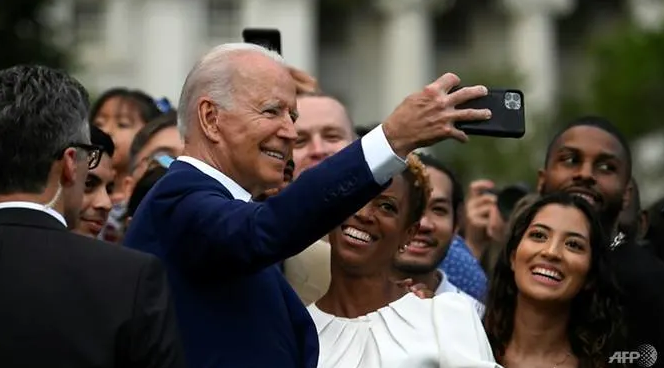
WASHINGTON: President Joe Biden celebrated United States Independence Day on Sunday (Jul 4) with an upbeat assessment of a country he said is roaring back to post-pandemic life, even if COVID-19 has yet to be fully “vanquished”.
Speaking before a festive crowd of 1,000 guests on the White House South Lawn, Biden drew a comparison between the declaration of independence from the British Empire in 1776 and today’s rapid recovery from the coronavirus.
“Two hundred and forty five years ago, we declared our independence from a distant king. Today, we are closer than ever to declaring our independence from a deadly virus,” he told the crowd of invited military members and essential workers.
“We’ve gained the upper hand against this virus,” he said. But he added: “Don’t get me wrong: COVID-19 has not been vanquished. We all know powerful variants have emerged, like the Delta variant.”
READ: Americans’ July Fourth festivities sparkle after last year’s COVID-19 cancellations
Biden paid tribute to those who have lost their lives, with the staggering number of deaths in the US now at more than 600,000.
But he struck an overwhelmingly optimistic note, suggesting that under his leadership the country – bitterly and at times violently divided during the Donald Trump presidency – was “coming back together.”
“Over the last year, we have lived through some of our darkest days,” Biden said. “We are about to see our brightest future.”

VACCINATION CONCERNS
Large crowds packed the National Mall for a huge fireworks display in yet another sign that the US is looking to its July Fourth holiday as a moment to put the virus in the rear view mirror.
During last year’s holiday, with the pandemic near its summer peak and towns across America reeling from anti-racism and anti-police protests, Washington and other big cities held only muted celebrations.
Despite the atmosphere of Sunday’s victory party, the Biden administration says it is concerned about the large numbers of people who have still not got vaccinated.
READ: US administers 330.6 million doses of COVID-19 vaccines
The heavily promoted White House goal of getting seven in 10 adults their first shot by Independence Day has narrowly failed.
And when it comes to full vaccinations, only 46 per cent of Americans have taken the two doses.
That lag comes as the highly contagious Delta variant continues to spread.
Public health officials are eyeing swaths of rural America where hospitals are starting to fill up again, especially in Utah, Missouri, Arkansas and Wyoming.
Anthony Fauci, America’s top infectious disease expert, told NBC that unvaccinated people now account for 99.2 per cent of COVID-19 deaths.
SUMMER AGENDA
The fireworks smoke will have barely cleared before Biden has to return to a complex political fight for the survival of his legislative agenda this summer.
Negotiations continue on a bipartisan infrastructure deal, and fractious debate within his Democratic Party looms on a much broader spending package that has no support from Republicans.
The president visited a cherry farm in Michigan on Saturday to tout a positive June employment report hailed as a sign of America’s economic resurgence.
In his speech on the South Lawn, Biden said that the country was on the move again. “We’re seeing record job creation and record economic growth – the best in four decades and, I might add, the best in the world.”
READ: Progress on COVID-19 and economy under Biden, but disunion haunts US on its 245th birthday
“AMERICAN DREAM”
The administration also sent Cabinet secretaries and other officials to sports events, cookouts and festivals nationwide as part of its “America’s Back Together” celebration.
And the White House – at least outwardly – continues to brim with confidence. Six in 10 respondents in a new poll by the Washington Post and ABC News give Biden positive ratings for his handling of the pandemic.
Images of a crowded South Lawn were echoed in scenes of celebration across the country, with New York, Chicago, Las Vegas and other cities all putting on their own shows.
On the west coast, San Diego was readying to stage one of the largest July Fourth parties in the country, with fireworks discharged from four barges around the bay.
California Senator Alex Padilla called Independence Day “a reminder of the American dream”.
“The best way to celebrate Independence Day is by taking a moment to acknowledge all the hard work that it took to get here,” he said.
Source: AFP/kg
Canada’s Hong Kong diaspora helps new arrivals with jobs, housing, psychotherapy
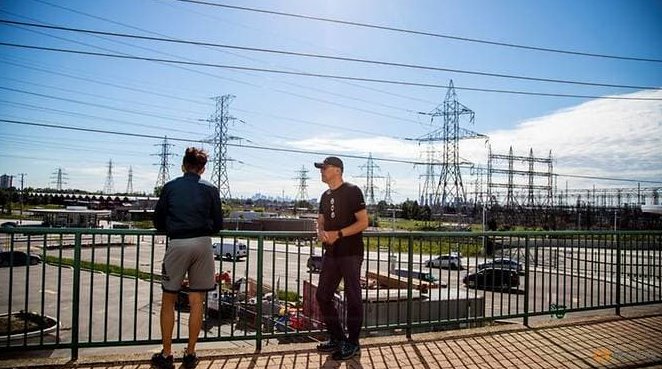
OTTAWA: Hong Kongers in Canada are banding together to help the latest wave of immigrants fleeing Beijing’s tightening grip on their city.
Networks across the country, some descended from groups set up after the Tiananmen Square incident in China in 1989, are offering new arrivals everything from jobs and accommodation to legal and mental health services and even car rides to the grocery store.
“We are in a battle. These are my comrades, people who share the same values,” one 38-year-old who asked to be identified only as Ho told Reuters. “Who is going to provide that helping hand if I’m not going to?”
Ho runs a cooking school near Toronto, and said he hired a former aide to a Hong Kong democratic politician to promote his business online, and recently took on a new kitchen assistant who took part in the city’s 2019 protests.
Ho, who came to Canada as a teenager before Britain handed Hong Kong back to China in 1997, is just one person helping the network of support groups that have been formed in Toronto, Vancouver, Calgary and Edmonton in the past two years.
Immigrants looking after each other is not unique. But people in Canada, which has one of the world’s biggest overseas concentrations of people from Hong Kong, told Reuters the situation is urgent because many of the people they are seeking to help fear they will be arrested for taking part in past protests and may not be able to afford professional help to resettle overseas.
“It’s my natural duty,” said Ho, who asked not to be identified by his full name, and did not name his new employees, for fear of problems with Hong Kong authorities. “If I was in Hong Kong, I would be in a desperate position. If there was a helping hand, I would hold onto it.”

Beijing imposed a sweeping national security law on Hong Kong a year ago, outlawing a wide range of political activities and effectively putting an end to public protests. Many pro-democracy activists and politicians, including prominent Beijing critics Joshua Wong and Jimmy Lai, have been arrested under the new law or for protest-related offences. Many people have already left the territory.
READ: Hong Kong court denies bail to democracy activist
The Hong Kong government and China say the law was necessary to restore stability after the sometimes violent protests of 2019, and that it preserves freedoms guaranteed by Beijing after Britain handed Hong Kong back to China.
“The Hong Kong national security law upholds the rights and freedoms of Hong Kong people,” said a spokesperson for Hong Kong’s Security Bureau. “Any law enforcement actions taken by Hong Kong law enforcement agencies are based on evidence, strictly according to the law, for the acts of the persons or entities concerned.”
CANADIAN ‘PARENTS’
Britain and Canada are two of the most popular destinations for people leaving Hong Kong after the imposition of the national security law.
About 34,000 people applied to live in Britain in the first two months after the country introduced a new fast-track to residency for Hong Kongers earlier this year, according to the Migration Observatory at the University of Oxford, citing government data.
About a fifth of that number applied for temporary and permanent residency in Canada in the first four months of this year, according to the government. The total number of Hong Kongers going to Canada is likely larger but hard to track as many already hold Canadian passports from earlier waves of emigration.
Hundreds of thousands of Hong Kongers moved there in the 1980s and 1990s for fear they would lose wealth and property, or much of their freedom, after China took back control of the city.
But the city prospered and retained freedoms unavailable in mainland China, so many Hong Kongers returned home, with some keeping a foot in Canada. The latest wave of emigration looks more likely to be permanent, as China stamps its authority on Hong Kong.

Canada loosened its restrictions on admitting Hong Kongers after the imposition of the national security law last year. It set up a new work visa programme aimed chiefly at young Hong Kongers with a degree or diploma from a post-secondary institution in the last five years, along with two pathways to permanent residency for Hong Kongers in Canada who have recently worked or completed post-secondary studies in the country.
The new coronavirus has complicated matters for new arrivals. Under Canada’s latest travel restrictions, even those who have obtained permission to live and work in Canada through the new programme are only allowed to enter the country if they have a job offer.
READ: Hong Kong silenced as China celebrates Chinese Communist Party centenary
That is where the support network comes in. The Toronto Hong Kong Parent Group has so far assisted 40 people, half of whom have already received three-year permits, according to Eric Li, co-founder of the group and former president of the Canada-Hong Kong Link, a rights advocacy organisation established in 1997.
Li said the group has encouraged 20 employers to offer jobs to people arriving from Hong Kong, including Ho’s cooking school, restaurants, a construction company, a travel agency, and a family who hired a Cantonese tutor for their children.
The Toronto group also has interpreters, lawyers and psychotherapists on hand to help new arrivals and has 10 rooms it can provide as free, temporary accommodation. The rooms are in the members’ or their friends’ homes.
Volunteers in Calgary said they have helped at least 29 asylum seekers, picking many up from the airport and driving them to doctors’ offices, grocery stores and banks.
STEPPING STONE
Canada has long had one of the largest populations of overseas Hong Kongers, some of whom came together in 2019 to hold rallies in solidarity with the protests back home.
Many of the new groups can trace their roots to activist organisations that formed in response to Beijing’s crackdown on pro-democracy protesters in and around Tiananmen Square in 1989, or the 1997 handover. The groups already have contacts with social agencies, such as Community Family Services of Ontario or the York Support Services Network, or with churches and professionals willing to help.
READ: Hong Kong security law ‘a human rights emergency’: Amnesty
The Vancouver Parent Group, supported by the Vancouver Society in Support of Democratic Movement that formed in 1989, has raised more than C$80,000 (US$65,963) to help Hong Kong protesters settling in Canada with living costs and legal fees.
Vancouver “parents” show new arrivals how to navigate public transport or get a library card, and organise donations of winter clothing or kitchenware, according to Ken Tung, one of the volunteers.
Tung said their aim is to “give them a stepping stone to move on.”

Alison, a protester who left Hong Kong last year after many of her friends there were arrested for taking part in protests, was one of those helped by the Calgary group.
Along with a few other new arrivals, she launched the Soteria Institute, named after the Greek goddess of safety and salvation, to offer free, weekly, online English lessons, resume-writing workshops and emotional support.
“We understand what they’re experiencing,” said Alison, who asked to be identified by only one name. “We try to use our experience to help out more Hong Kong exiles.”
Source: Reuters/ec
 English
 简体中文
简体中文 Bahasa Indonesia
 Bahasa Melayu