
Covid-19 (April 18): 2k cases for fourth consecutive day, new record in K’tan

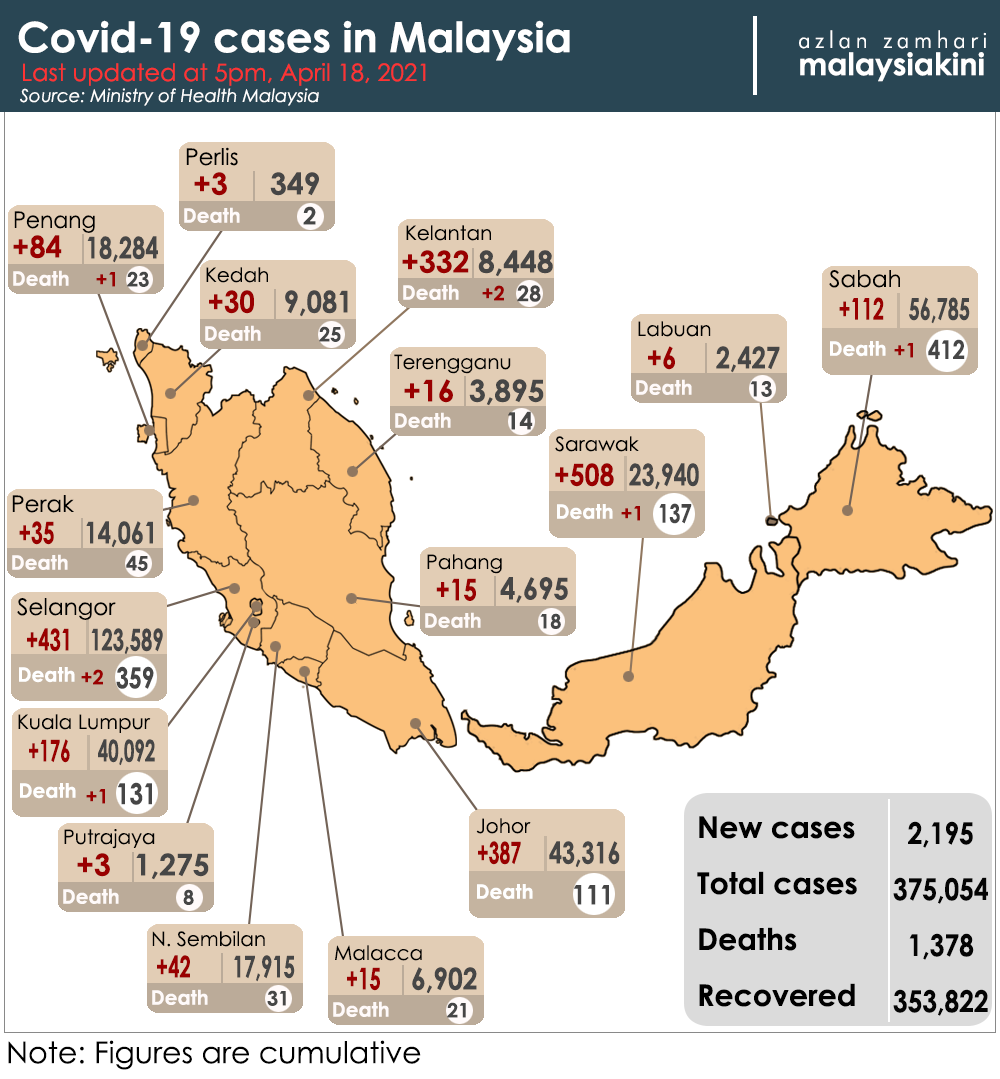
COVID-19 | The Health Ministry today reported 2,195 new Covid-19 cases, the fourth consecutive day where daily fresh infections are above 2,000.
Sarawak topped the chart with 508 new Covid-19 cases. The state reported the most number of fresh infections in five out of the last seven days.
Meanwhile, the situation in Kelantan appears to be deteriorating with 332 new Covid-19 cases, a record high for the state.
Johor also saw an elevated number of cases at 387, the highest since March 5.
The new infections comprised 83.69 percent Malaysians and 16.31 percent non-citizens.
Active cases continued to rise steeply as the number of new cases significantly outstripped recoveries. A total of 1,427 Covid-19 patients recovered today.
- Active cases: 19,854
- Patients in ICUs: 219
- Intubated: 90
Deaths
There were eight fatalities today, bringing the death toll to 1,378.
The new deaths were recorded in Selangor (2), Kelantan (2) Kuala Lumpur (1) Sarawak (1), Sabah (1) and Penang (1).
Those who died were aged between 37 and 90.
For a detailed breakdown of the reported deaths today, please refer to our Covid-19 tracker site.
New cases by states
Clusters
A total of 338 out of 1,520 clusters are still active. From the active clusters, 64 of them contributed to the new cases today.
This includes the five clusters reported today. Another 14 clusters were declared resolved.
The resolved clusters are: D Gana, Jalan Permas Baru, Buloh Pasi, Sena, Industri Inanam, Perusahaan 10, Tapak Bina Queens Waterfront, Sungai Bakong, Jalan Kayu Manis, Dataran Utas, Bukit Tambun, Jalan Lapan Belas, Jalan Sutera and Jalan Green.
Details of the new clusters are as follows:
Selat Klang cluster
District(s): Klang and Petaling in Selangor
Locality/Source: A company at Jalan Pelabuhan Utara, Pelabuhan Klang, Selangor
Cluster category: Workplace
First case: April 14
Total infected: 25 out of 101 screened
Tapak Bina Cahaya Alam cluster
District(s): Petaling in Selangor
Locality/Source: A construction site at Cahaya Alam, Shah Alam
Cluster category: Workplace
First case: April 10
Total infected: 20 out of 203 screened
Jalan Perindustrian Satu cluster
District(s): Muar in Johor
Locality/Source: A collection of factories at Jalan Perindustrian 1, Batu 8, Kawasan perindustrian Bukit Bakri, Muar.
Cluster category: Workplace
First case: April 14
Total infected: 254 out of 980 screened
Tarat Tani cluster
District(s): Serian in Sarawak
Locality/Source: Index case’s residence at Tarat, Serian
Cluster category: Community
First case: April 11
Total infected: 21 out of 320 screened
Jalan Bintulu Sibu cluster
District(s): Tatau and Bintulu in Sarawak
Locality/Source: An education institution at Jalan Bintulu Sibu, Tatau
Cluster category: School / Education Ministry’s institution
First case: April 9
Total infected: 11 out of 546 screened
Source:Malaysiakini
Commentary: China’s pineapple ban another prickle in relations with Taiwan
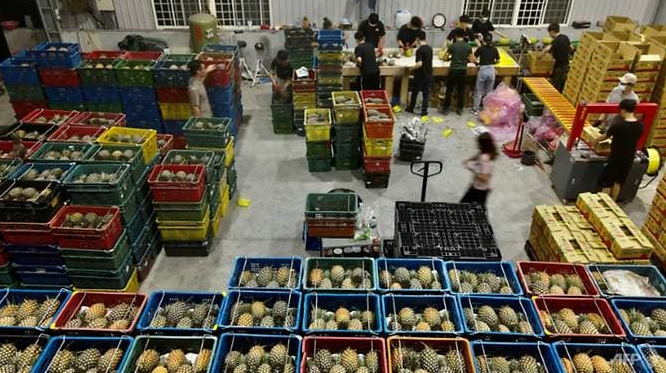
ATLANTA, Georgia: Beijing suddenly announced on Feb 26 that it would suspend pineapple imports from Taiwan starting Mar 1, citing pests detected on the pineapples.
The Taiwan pineapple ban is reminiscent of China’s ban on Philippine bananas in the aftermath of the Scarborough Shoal standoff in April 2012, when China similarly cited pests on Philippine fruits to deny their importation.
Taiwan’s partners, including Japan and the United States, quickly took action to show their solidarity with the island.
Unlike the banana ban in 2012, this pineapple ban’s timing appears mysterious because no incident preceded the suspension. Taiwan President Tsai Ing-wen called the announcement “ambush-like”.
TRIANGULAR DYNAMICS
The larger background to this ban involves the triangular dynamics between Beijing, Taipei and Washington.
The Biden administration’s statements and actions since its inauguration indicate that it will continue the Trump administration’s strong support of Taiwan.
READ: Commentary: How China will try to subdue Taiwan – without firing a bullet
The pineapple ban is Beijing’s signal to Taipei that it cannot circumvent the influence of Beijing over its affairs, even with US support.
The ban could also be explained with reference to Taiwan’s pro-independence Democratic Progressive Party (DPP) government having recently reshuffled its Mainland Affairs Council (MAC).
The new MAC head has signalled optimistic expectations in breaking the cross-Strait impasse.
The pineapple ban lays bare the reality of cross-Strait relations when there is no official channel to deal with an issue as minor as “harmful creatures” found on pineapples.
READ: Commentary: Continued US trade war with China could stoke inflation
Beijing reiterated its political precondition for exchange – that Taipei needs to find a way to come to terms with Beijing’s “one China” principle – and laid the blame for disrupted cross-Strait relations on the DPP government.
The ban might just be another attempt to squeeze Taiwan, the newest measure in a long process that kicked off in 2016.

China has thwarted Taiwan’s international participation, most noticeably in the World Health Organization (WHO) during the pandemic.
The Chinese military has increased its vessels in areas around Taiwan, most recently intruding into Taiwan’s southwest air defence identification zone.
Economically, China has cut tourists to Taiwan and suspended its contract production with the island. The pineapple ban falls under this last category of measures.
APPLYING CORE PRESSURE
Beijing’s aim is not to economically sanction Taiwan as a whole but to target sanctions against the DPP’s core constituencies.
These include the so-called “three middles and one youth” who tend to be more sympathetic to the DPP: Middle-to-small businesses, middle-to-southern Taiwan, middle-to-low-income people, and Taiwan’s youth.
READ: Commentary: China’s foreign loans, as a recent study shows, is full of ‘Chinese characteristics’
The pineapple farmers fall into the overlap of several of these categories. It has been rumoured that China’s next sanction target might be wax apples, predominantly grown in southern Taiwan.
Since the ban, Taipei has tried to highlight what it perceives as Beijing’s coercion and has sought to garner international support by launching a #FreedomPineapples campaign. The slogan mimics the #FreedomWine tagline supporting Australian wines sanctioned by China.

Australia and Taiwan’s cases are similar because China denied access to its massive market as a tool of economic coercion to signal its displeasure with Canberra’s and Taipei’s political behaviour.
Both instances also show China’s preference for grey-zone trade coercion by cutting off market access on regulatory grounds. This form of coercion allows China to deny it is using economic sanctions.
ONE CHINA POLICY
The cases of Australia and Taiwan also differ in significant ways. China’s dispute with Taiwan is fundamentally about Taiwan’s status — the “one China” issue — which China does not expect to find a solution to in the short term.
READ: Commentary: Don’t be too quick to dismiss the economic benefits of RCEP for Southeast Asia
China’s disputes with Australia are about Canberra’s policies, including the banning of Huawei in Australia’s 5G construction and calling for an independent investigation into China’s handling of the COVID-19 outbreak.
Policy issues between China and Australia will shift continually. Beijing has targeted some of Australia’s largest exports to China to deter Canberra from encroaching on China’s interests in the future.

Beijing has not targeted Taiwan’s top exports to China. Taiwan’s pineapples rely primarily on the domestic market, with exports to China only accounting for 9 per cent of sales. China also hopes to win Taiwan’s hearts and minds.
Following the pineapple ban, Beijing announced a package of 22 new incentive measures, including offering land and financial support to encourage Taiwan’s agricultural businesses to invest in China.
If China presses too hard on Taiwan’s status, there is a genuine risk that economic coercion could transition into armed conflict. Taipei may show its defiance by moving towards independence and this might force Beijing’s hand.
READ: Commentary: The broader dialogue the US-China relationship needs
READ: Commentary: The Quad has a plan and it’s not all about China
China has avoided putting all-out economic pressure on Taiwan to allow both sides an opportunity to maintain peace, despite an increasingly tense relationship.
The pineapple ban might not actually be pre-meditated and China’s phytosanitary concerns could be real.
But by choosing not to talk to Taipei to resolve the issue, Beijing’s message has been delivered: Taiwan cannot circumvent China and, without a common political understanding, breaking the cross-Strait impasse will remain wishful thinking.
Dalton Lin is Assistant Professor at the Sam Nunn School of International Affairs, Georgia Institute of Technology, and the Executive Editor of Taiwan Security Research. This commentary first appeared on East Asia Forum. Read it here.
Source: CNA/ml
Source : Malaysiakini
 English
 简体中文
简体中文 Bahasa Indonesia
 Bahasa Melayu
Get the expert view